

Every day, somewhere in the world, a curious person opens a laptop and types something like “how do I get into data science?” Ever looked at job listings and felt like data science requires everything, coding, statistics, business sense, and somehow… experience you don’t yet have? You’re not imagining it. The field can feel awe-inspiring at first.
But here’s the truth: data science isn’t about knowing everything, it’s about knowing what to learn, when to learn it, and how to apply it.
This guide breaks it all down for you: skills, tools, courses, and career prep, so you can move from confusion to clarity. If that sounds like you, good news: you’ve landed in the right place. This guide is intended to give you a clear, honest, and actionable roadmap, not a generic list of buzzwords, but a real path from beginner to job-ready data scientist.
36% Projected job growth for data scientists by 2033, according to the U.S. Bureau of Labor Statistics, nearly 10 times the average for all occupations. Similar acceleration is being tracked across the EU, Southeast Asia, and the Gulf region.
Why Data Science, and Why Now?
Let’s start with why this path is worth your time. Data science has moved from a niche specialty to organizational backbone in under a decade. Industries from healthcare and finance to agriculture and retail are making decisions that are progressively powered by data analysis, machine learning, and predictive modeling.
Globally, organizations across industries, from healthcare to finance to education, are investing heavily in data-driven decision-making.
What does that mean for you?
More demand. More opportunities. And more room for career growth.
The 4-phase Roadmap
Think of your data science journey in 4 broad phases. You won’t essentially move through them in a straight line, but this structure gives you orientation.
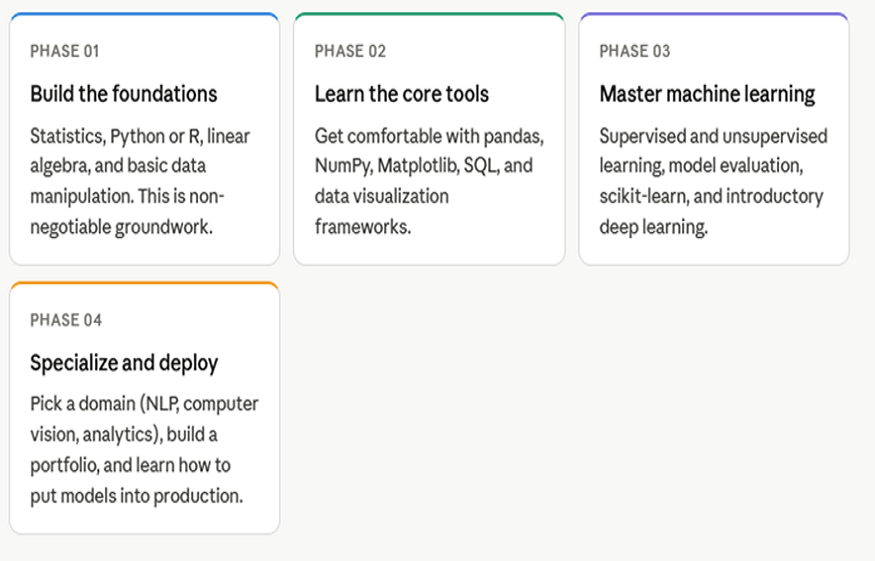
Build the Correct Foundation (Without Overcomplicating It)
Before jumping into tools or advanced courses, focus on the core building blocks.
1. Statistics & Mathematics
You don’t need to be a math genius but you do need to understand:
- Probability
- Distributions
- Hypothesis testing
- Basic linear algebra
These concepts help you understand data,not just process it.
2. Programming (Start with One Language)
Most novices start with:
- Python (highly recommended for beginners)
- R (great for statistical analysis)
Focus on writing clean, simple code rather than trying to master everything at once.
3. Learn the Important Tools (The Real Industry Stack)
Curricula can be theoretical. Job listings are not. Here are the tools that constantly appear in data science job postings across the world:
Once your basics are clear, it’s time to get hands-on:
Data Handling & Analysis
- Pandas (Python library)
- NumPy
- Excel (yes, still relevant!)
Data Visualization
- Matplotlib / Seaborn
- Tableau / Power BI
Databases
- SQL (non-negotiable skill)
Machine Learning
- Scikit-learn
- TensorFlow or PyTorch (for advanced learners)
Here’s the key: don’t just learn tools, use them to solve problems. Build small projects like analyzing sales data or predicting trends.
Choosing the Accurate Educational Path
This is where the conversation gets personal, because the “right” path genuinely depends on your situation, your budget, timeline, existing background, and career goals. You have three main options:
Self-Learning (Flexible but Requires Discipline): Online platforms, YouTube, and free resources can take you far but consistency is everything.
Certification Courses: Short-term programs help you gain structured knowledge and practical exposure.
Advanced Degrees (For Long-Term Growth): If you’re serious about building a strong, future-proof career, a Master of Science in Data Science can give you a significant edge. It offers:
- In-depth technical knowledge
- Exposure to real-world datasets
- Research and specialization opportunities
- Stronger credibility in global job markets
For working professionals, an Online Master’s Degree in Data Science is often the smarter choice. It allows you to:
- Learn while working
- Apply concepts in real-time
- Avoid career breaks
- Gain globally recognized qualifications
That’s where a formal Master of Science in Data Science becomes genuinely valuable, not because employers always require one, but because it provides something self-paced courses rarely do: structured rigor, faculty relationships, research exposure, and a credential that opens doors. For working professionals who can’t relocate or take a career break, the rise of the Online Master’s Degree in Data Science has been nothing short of transformative.
Building a Portfolio that Gets Responses
Recruiters don’t just care about what you know, they care about what you can do.
In data science, the portfolio often matters more than the resume. Recruiters and hiring managers want to see that you can actually solve problems not just that you completed courses. A strong portfolio typically includes three to five end-to-end projects hosted on GitHub, a writeup explaining your methodology, and ideally at least one project connected to a domain you’re targeting.
Don’t underestimate the power of writing. Data scientists who can communicate findings clearly in notebooks, blog posts, or stakeholder presentations are significantly more hireable than those who can only code. Upload your work to GitHub and explain your thought process clearly. This alone can set you apart from hundreds of applicants.
Career Prep: What to Actually Do in the Last 3 Months?
When you’re in the final stretch before job applications, the temptation is to keep learning. Resist it. The last three months should be about application, not accumulation. Refine two or three portfolio projects until they’re sincerely polished. Practice explaining your work out loud the classic “tell me about a project you’re proud of” question catches more candidates off guard than any technical test. Engage with communities: local data meetups, Discord servers, LinkedIn, Slack groups.
Breaking into data science isn’t just about learning, it’s about positioning yourself. Also, this is worth saying simply tailor your job search geographically. If you’re based in Nairobi, São Paulo, or Jakarta, look inward first. Regional companies often offer faster career advancement, greater ownership, and compensation that goes much further locally. Remote-first companies are also worth targeting; many actively hire worldwide for data roles.
One of the most exciting and challenging things about data science is that it keeps evolving. New tools, new frameworks, new techniques. That’s why continuous learning is key.
Even after completing a Master of Science in Data Science or an Online Master’s Degree in Data Science, professionals frequently upskill through:
- Workshops
- Certifications
- Industry projects
Common Mistakes to Avoid
- Let’s save you some time and frustration.
- Trying to learn everything at once
- Skipping fundamentals and jumping into AI/ML
- Not building projects
- Waiting to “feel ready” before applying for jobs
Progress in data science comes from doing, not just learning.
Final Thoughts: Your Roadmap, Your Pace
Data science is a genuinely exciting field, but it rewards people who approach it with patience and specificity. Know which corner of the field interests you. Build real things. Get feedback. If there’s one thing to remember, it’s this: You don’t need to have it all figured out from day one.
Start small. Stay consistent. Build as you learn. Whether you choose self-learning, certifications, or a structured path like an Online Master’s Degree in Data Science, what matters is momentum.
Because in a world driven by data, the people who understand it don’t just find jobs, they shape decisions, industries, and the future itself. And that journey? It can absolutely start with you. The world needs people who can make sense of its data. The roadmap is clearer than ever. The only remaining variable is whether you start.